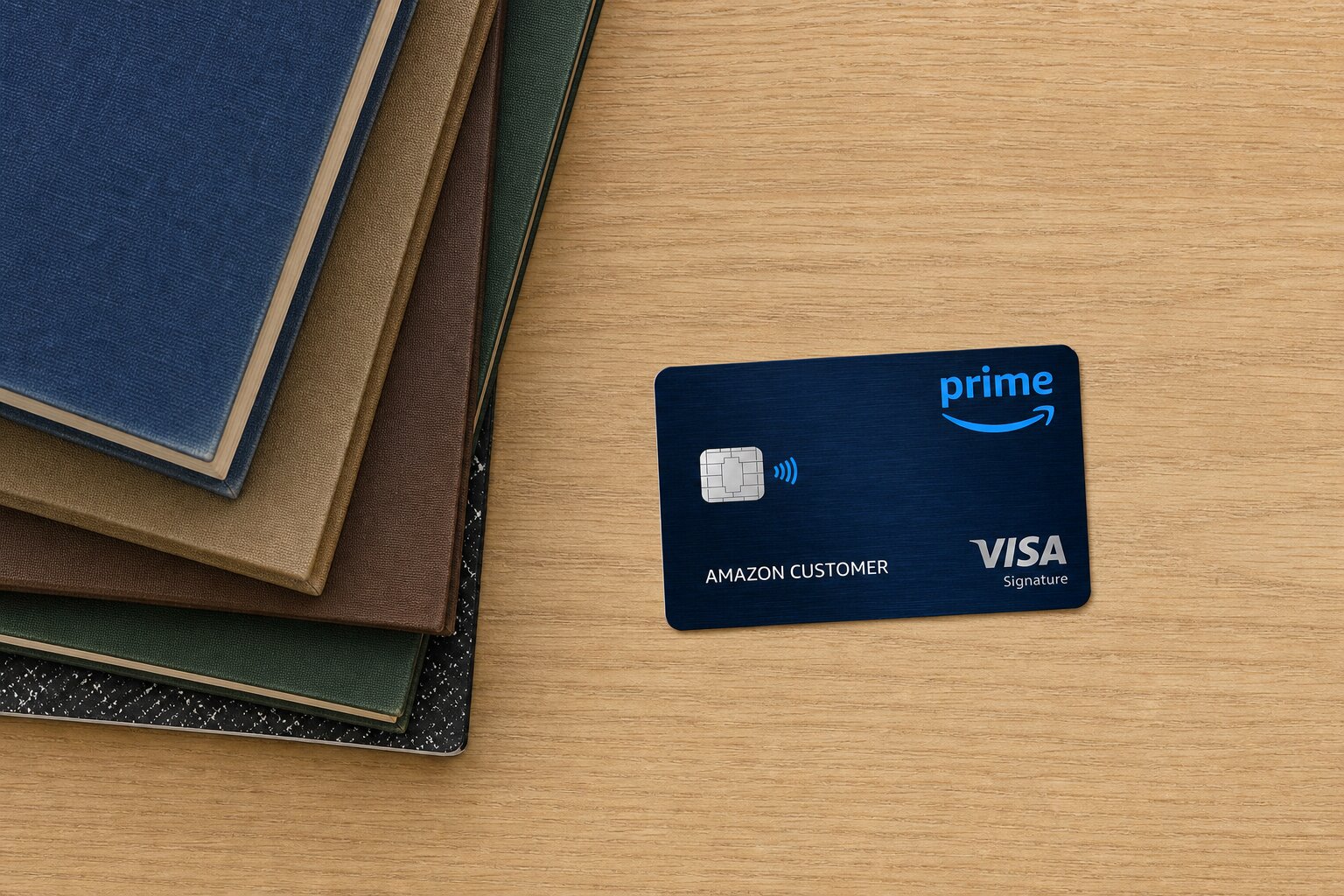
If you spend a few hundred dollars a month on Amazon — and a lot of people do — the math on the Amazon Prime credit card gets interesting fast. Five percent back on every Amazon order, plus the same 5% at Whole Foods, with no annual fee on the card itself. For a household that runs groceries, household goods, and the occasional impulse buy through Amazon, that's real money: spend $6,000 a year there and you're pocketing $300 in rewards. The catch is that those rewards only ever spend in one place, and the "free" card sits behind a $139 Prime membership. This review of the Amazon Prime credit card walks through who actually comes out ahead.
First, a clarification that trips up almost everyone shopping for the chase prime credit card: there are two completely different cards with nearly identical names.
The Two Cards Hiding Behind One Name
The Prime Visa — the prime chase card most people mean — is issued by Chase. It's a full Visa Signature card, which means you can swipe it anywhere Visa is accepted, not just at Amazon. The amazon prime store card is a different product issued by Synchrony, and it's "closed-loop," a term that just means it works only on Amazon and Amazon-affiliated purchases. You can't buy gas or pay a restaurant with the store card.
That single difference drives almost everything else. Because the Chase card is a real Visa, it generally wants good credit (think a FICO score in the 690+ range) and comes with a variable purchase APR around 18.74% to 27.49% as of June 2026. The Synchrony amazon prime store card is easier to get approved for — fair credit often qualifies — but it carries a steep flat APR near 29.49% and a late fee of up to $40. For most readers, when we say "the amazon prime credit," we mean the Chase Prime Visa, so that's where the rest of this review focuses.
What the Prime Visa Actually Pays
Here's the rewards structure on the chase prime credit card, in plain terms:
- 5% back at Amazon, Amazon Fresh, Whole Foods Market, and Chase Travel
- 2% back at gas stations, restaurants, and on local transit
- 1% back on everything else
There's no annual fee for the card, and new cardholders typically get a $100 Amazon gift card just for being approved. That's a clean, no-strings welcome offer — no minimum spend to hit, unlike the $3,000-plus thresholds on most sign-up bonuses.
But two important limits separate this card from a great all-around rewards card. First, that 5% rate is only "free" if you already pay for Prime, which runs $139 a year. If you're buying the membership only to unlock the card's earning rate, you'd need to spend roughly $2,800 a year on Amazon just to break even on the membership cost before the card earns you a net dollar. For genuine heavy Amazon users that's nothing; for occasional shoppers it's the whole ballgame.
Second — and this is the part bank marketing tends to bury — the rewards are not Chase Ultimate Rewards points. Even though Chase issues the card, the points you earn are Amazon Rewards points. They redeem for Amazon purchases, statement credits, or gift cards, and that's it. You cannot transfer them to airlines or hotels, you can't move them into a Sapphire account, and they're worth a flat one cent each. If you've read about transferring points to airline miles for 3–5x their value, none of that applies here. These points are Amazon credit in a different wrapper.
Where It Fits in Your Wallet
The honest verdict: the Prime Visa is an excellent supporting card and a mediocre only card. Its 5% Amazon rate is among the best retailer-specific earning rates you'll find with no annual fee, and the 2% on gas, dining, and transit is a respectable fallback. But the 1% on everything else is weak, and the locked-in rewards mean you should never run your whole financial life through it.
The smart play is to pair it with a flat-rate card. This is exactly the logic behind building a two-card wallet: use the Prime Visa for Amazon and Whole Foods, where it pays 5%, and put everything else on a card that pays 2% across the board. You capture the high category rate where it matters and stop leaking value on the 1% purchases. One caveat worth knowing — warehouse and wholesale spending can code in ways that surprise you, which is the kind of detail covered in how merchant category codes decide your rewards.
A few practical notes before you apply:
- You don't strictly need Prime to hold the card. Non-Prime members can get a version that pays 3% at Amazon instead of 5%. The 5% rate is the Prime-only perk.
- It earns nothing extra abroad in value, but it does carry no foreign transaction fees, which is a quiet plus for travelers.
- Carrying a balance kills the deal. At a ~27% APR, interest on a revolving balance dwarfs any 5% rewards. This card only makes sense if you pay in full every month.
Should You Get It?
Run a quick gut check. If you already pay for Prime, shop at Amazon or Whole Foods regularly, and pay your balance in full, the Prime Visa is close to a no-brainer — the $100 gift card and 5% rate pay for themselves quickly, and there's no annual fee eating into the rewards. If you don't have Prime and rarely shop at Amazon, skip it; a general 2% cash-back card will serve you better with rewards you can actually spend anywhere.
The amazon prime store card from Synchrony is worth considering only in one narrow case: you have fair credit, you're building your file, and your spending is genuinely Amazon-heavy. Otherwise the lower approval bar isn't worth giving up the flexibility of a real Visa.
Whichever way you lean, remember the cardinal rule of rewards cards — they reward you only if you treat them like a debit card with perks. As we've covered in whether you should put everything on a credit card, the rewards are real, but a single month of carried interest can erase a year of them. The Prime Visa is a sharp tool for a specific job. Use it for that job, pay it off, and let the 5% do its quiet work.