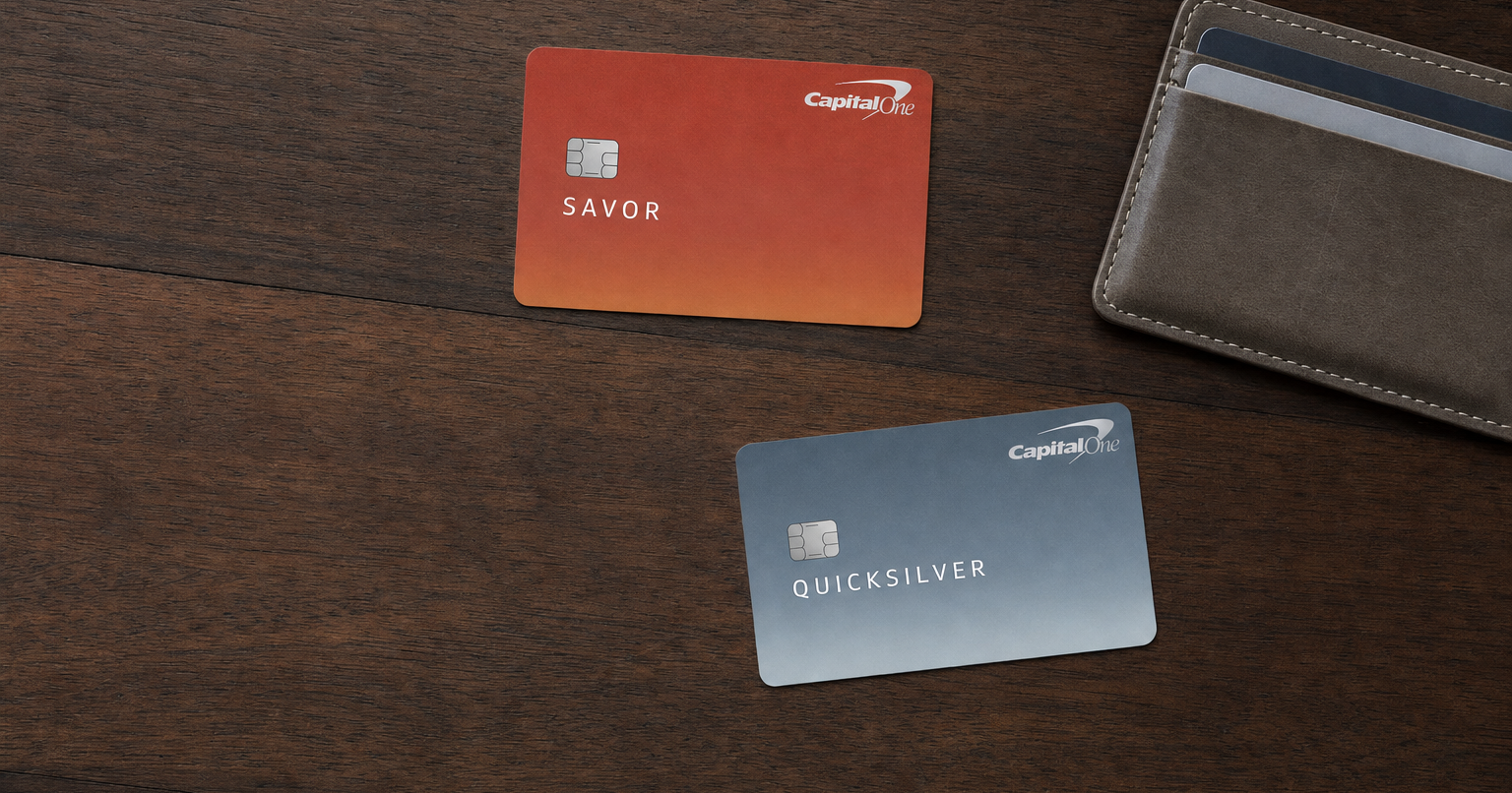
Both of these cards cost you nothing to hold, both come from Capital One, and both put cash back in your pocket with zero effort. So when people weigh the Capital One Savor vs Quicksilver decision, they usually assume it's a coin flip. It isn't. The right pick comes down to one number: how much of your spending goes to restaurants, groceries, and streaming. Get that number right and one card can quietly out-earn the other by $150 or more a year on the same purchases.
Here's the honest breakdown, with the math, so you can stop guessing.
The core difference: bonus categories vs a flat rate
The Savor and Quicksilver split along a classic fault line in the cash back world. The Capital One Savor pays a rich rate in a handful of categories and a mediocre rate everywhere else. The Quicksilver pays the same middling-to-good rate on absolutely everything.
The Savor earns unlimited 3% cash back on dining and restaurants, at grocery stores, on entertainment, and on popular streaming services — then drops to just 1% on everything outside those buckets. The Quicksilver keeps it dead simple: unlimited 1.5% flat cash back on every purchase, every day, no categories to track.
Everything else about these two is nearly identical, which is what makes the choice interesting.
| Feature | Capital One Savor | Capital One Quicksilver |
|---|---|---|
| Annual fee | $0 | $0 |
| Dining & restaurants | 3% | 1.5% |
| Groceries | 3% | 1.5% |
| Entertainment & streaming | 3% | 1.5% |
| Everything else | 1% | 1.5% |
| Capital One Travel (hotels, cars) | 5% | 5% |
| Capital One Entertainment | 8% | 5% |
| Welcome bonus | $250 after $500 spend in 3 months | $200 after $500 spend in 3 months |
| Intro APR | 0% on purchases for 12 months | 0% on purchases + balance transfers for 15 months |
| Regular APR (variable) | 23.49% | 23.49% |
| Foreign transaction fee | $0 | $0 |
Both cards let you redeem cash back with no minimums — as a statement credit, into a PayPal balance, or as a gift card — and neither caps the rewards in those core categories. Both also skip foreign transaction fees, so they travel well.
The break-even math that actually decides it
Forget the marketing. The only question that matters is where your dollars go. On bonus-category spending, the Savor beats the Quicksilver by 1.5 percentage points (3% vs 1.5%). On everything else, the Quicksilver wins by half a point (1.5% vs 1%). So the Savor is playing offense in a few categories while quietly losing a little ground everywhere else.
Run the numbers and there's a clean tipping point: the Savor comes out ahead once your dining, grocery, entertainment, and streaming spending is more than about 25% of your total spending. Below that line, the flat 1.5% Quicksilver earns more overall.
Most American households clear that 25% bar without trying. Say you put $1,500 a month on a card, and $500 of it is food, groceries, and Netflix:
- Savor: $500 × 3% + $1,000 × 1% = $15 + $10 = $25/month ($300/year)
- Quicksilver: $1,500 × 1.5% = $22.50/month ($270/year)
That's a $30/year edge for the Savor on identical spending — and it widens fast the more you eat out or feed a family. If groceries and restaurants are a big line item for you, the Savor isn't close; it's the obvious pick. Figuring out which purchases actually count is worth a few minutes, because card networks are picky about how a merchant is coded — our guide on how to categorize groceries, dining, and gas to maximize category multipliers walks through the traps.
One of those traps matters here: the Savor's 3% grocery rate excludes superstores like Walmart and Target, because they don't code as grocery stores. If most of your food shopping happens at a Walmart Supercenter, that 3% won't trigger, and the Quicksilver's guaranteed 1.5% may serve you better.
When the Quicksilver is the smarter card
The Savor wins on raw earning for most people, but the Quicksilver isn't a consolation prize. It wins outright in a few situations.
If your spending is spread evenly across a lot of categories — gas, home improvement, medical bills, subscriptions, random online orders — the flat 1.5% quietly out-earns a bonus card that only rewards a slice of your life. You never have to think about whether a purchase "counts."
The Quicksilver also has the better financing offer. It carries 0% intro APR for 15 months on both new purchases and balance transfers, versus the Savor's 12 months on purchases only. If you're planning a big purchase you'll pay off over a year, or you want to move existing high-interest debt to breathe, those extra three months and the balance-transfer option are worth real money. (There's a 3% balance transfer fee on the promo, which is standard.) If debt consolidation is your goal, it's worth reading up on how balance transfer cards work before you apply.
| Get the Savor if… | Get the Quicksilver if… |
|---|---|
| You spend heavily on dining out and groceries | Your spending is spread evenly across categories |
| You pay for multiple streaming services | You want one card and zero category tracking |
| You buy concert or event tickets | You're financing a purchase or a balance transfer |
| Food + fun is 25%+ of your spending | You shop mostly at Walmart/Target-type superstores |
| You want the bigger $250 welcome bonus | You want the longer 15-month 0% APR window |
Why not both?
Here's the move a lot of savvy Capital One cardholders make: they carry both. Since neither charges an annual fee, there's no cost to holding the pair. You run all your dining, groceries, entertainment, and streaming through the Savor for 3%, and everything else through the Quicksilver for 1.5% — instead of settling for 1% on your non-bonus spending. That combination beats either card alone and is the backbone of a simple, high-earning setup. We break down that exact strategy in how to build the perfect two-card wallet for maximum rewards.
One catch to plan around: Capital One generally lets you open only about one new card every six months, so you can't grab both on the same day. Start with whichever card matches your biggest spending category, hit the welcome bonus, then add the second one down the road.
The bottom line
If you spend a meaningful chunk on food, groceries, and entertainment — and most people do — the Capital One Savor is the better cash back card, full stop. Its 3% in the categories you use every day plus the larger $250 welcome bonus add up to more money back for the same purchases. Reach for the Quicksilver instead if you value one-card simplicity, your spending is genuinely all over the map, or you need the longer 15-month 0% APR to finance something or move a balance. And if you can't decide, the no-annual-fee math says you may not have to choose at all.