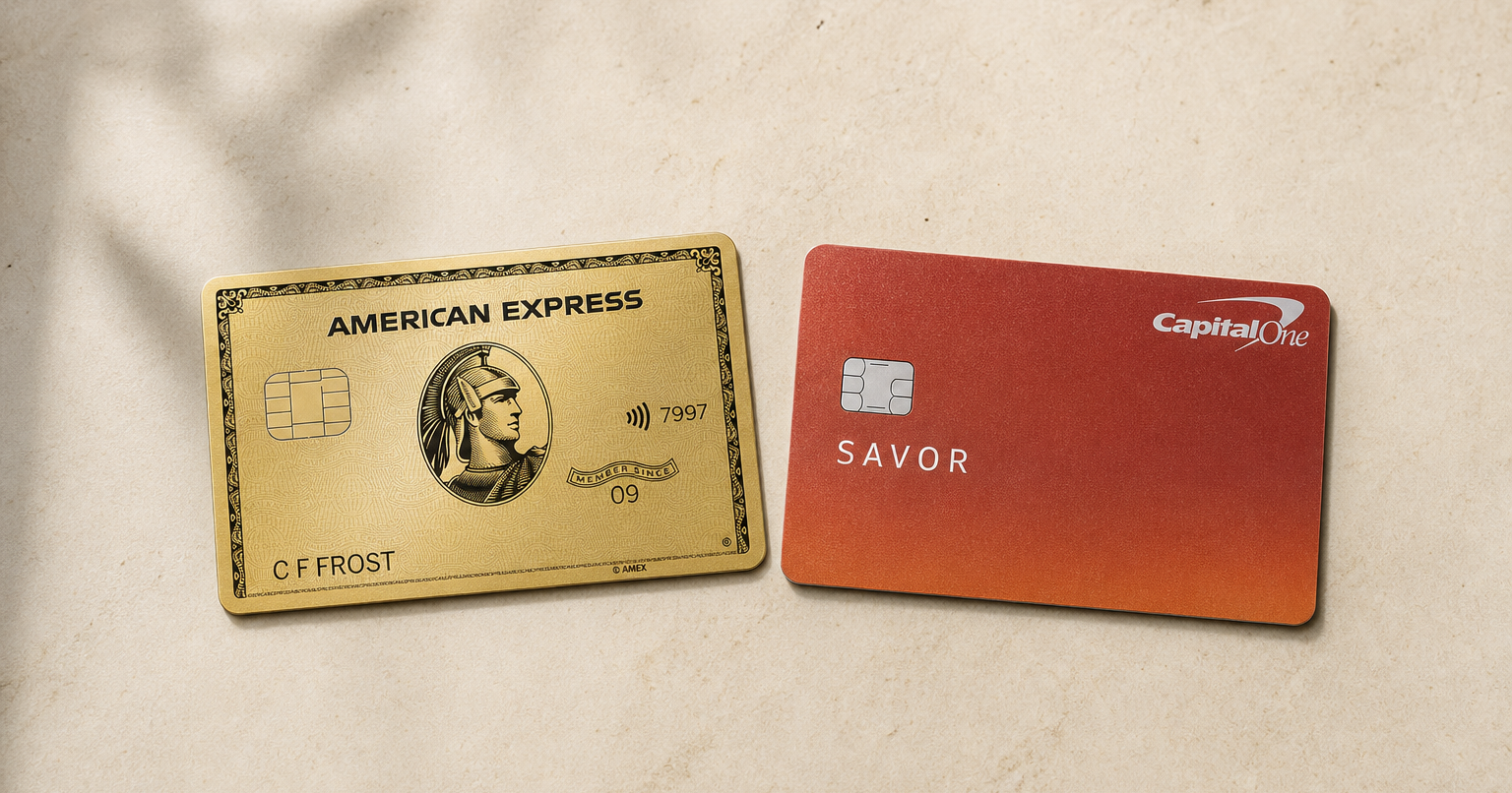
On paper these two cards chase the same person: the one whose bank statement is mostly restaurants, grocery runs, and takeout. But they go about it in completely different ways. The Amex Gold charges a $325 annual fee and hands you transferable points plus a pile of monthly credits. The Capital One Savor charges nothing and just deposits cash back. So the Amex Gold vs Capital One Savor question isn't really about who earns more on a burrito — it's about whether you'll do the work to justify a $325 fee, or whether you'd rather keep it simple and keep the money.
Let's put both cards on the table, literally.
How each card earns
The Amex Gold is a points card. It earns 4X Membership Rewards points at restaurants worldwide (on up to $50,000 a year) and 4X at U.S. supermarkets (on up to $25,000 a year), plus 3X on flights and 5X on prepaid hotels booked through Amex Travel. Everything else earns 1X. Those points aren't worth a flat penny each — cash out and you get about 1 cent apiece, but transfer them to Amex's 20-plus airline and hotel partners and frequent flyers routinely squeeze out 2 cents or more per point.
The Capital One Savor is a cash back card, and there's no guessing about value. It pays 3% cash back on dining, at grocery stores, on entertainment, and on streaming services, 8% on Capital One Entertainment bookings, 5% on travel booked through Capital One Travel, and 1% on everything else. A dollar back is a dollar.
| Category | Amex Gold | Capital One Savor |
|---|---|---|
| Annual fee | $325 | $0 |
| Restaurants / dining | 4X points | 3% cash |
| U.S. supermarkets / groceries | 4X points (up to $25k/yr) | 3% cash |
| Entertainment & streaming | 1X points | 3% cash |
| Flights | 3X points | 1% (5% via Capital One Travel) |
| Everything else | 1X points | 1% cash |
| Welcome offer | Up to 100,000 points after $8,000 in 6 months | $250 after $500 in 3 months |
| Regular APR (variable) | 23.99% | 23.49% |
| Foreign transaction fee | $0 | $0 |
Two things jump out. First, the Savor rewards entertainment and streaming at 3%, where the Gold gives you a measly 1X — if concert tickets and a stack of streaming subscriptions are part of your life, that's a real Savor advantage. Second, the Gold's welcome offer is in a different universe: up to 100,000 points (worth roughly $1,000 at cash value, and considerably more toward travel) versus a $250 check.
The $325 fee and the credits that offset it
Here's where the Gold gets complicated. That $325 fee is partly designed to be clawed back through statement credits — but only if you actually use them:
- $120 Uber Cash ($10 a month, U.S. rides and Uber Eats)
- $120 dining credit ($10 a month at Grubhub, Five Guys, Cheesecake Factory, Wonder, and a rotating list)
- $100 Resy credit ($50 January–June, $50 July–December, at participating U.S. restaurants)
- $84 Dunkin' credit ($7 a month)
Add it up and it's up to $424 a year in credits against a $325 fee. On a spreadsheet, the card pays you to hold it. In real life, these are what people call "coupon-book" perks — they only count if your actual habits line up with them. If you don't take Ubers, don't eat at those specific chains, and forget the monthly Dunkin' credit, that $424 shrinks fast and you're just paying $325. Deciding whether a fee card earns its keep is the whole game with premium cards, and it's the same logic we walk through in cash back versus travel points in 2026.
The Savor has no such asterisks. There's nothing to activate, no monthly ritual, no fee to earn back. You spend, you get cash.
Running the numbers on real spending
Say you spend $800 a month on dining and $600 a month at the grocery store — a foodie household, $16,800 a year across both categories.
- Capital One Savor: $16,800 × 3% = $504 in cash, with a $0 fee. Net: $504.
- Amex Gold: $16,800 × 4X = 67,200 points. At 1 cent (cash), that's $672; subtract the $325 fee and you're at $347 net — worse than the Savor. But use even $300 of the credits and value the points at 2 cents toward travel, and the same spend throws off ~$1,344 in travel value minus $25 net fee = well over $1,000.
That gap is the entire decision. The Gold's ceiling is far higher, but only if you (a) redeem points for travel rather than cash and (b) actually use the credits. Strip those away and a no-fee 3% cash card quietly beats it. If you're the type who forgets to categorize spending or cash out points strategically, that's worth knowing about yourself — our guide to maximizing category multipliers is only useful if you'll act on it.
One more detail both cards share: the 4X/3% grocery rate excludes superstores and warehouse clubs like Walmart, Target, and Costco, which don't code as supermarkets. If that's where you buy food, neither card's grocery bonus will fire.
Who should get which
| Get the Amex Gold if… | Get the Capital One Savor if… |
|---|---|
| You redeem points for travel via transfer partners | You want straight cash, valued at 100 cents on the dollar |
| You'll actually use the $424 in monthly credits | You don't want to babysit monthly coupons |
| You spend heavily at restaurants and supermarkets | You spend on entertainment and streaming (3% vs 1X) |
| A $1,000+ welcome bonus moves the needle for you | You refuse to pay a $325 annual fee |
| You want premium travel perks and hotel earning | You want set-and-forget simplicity |
The bottom line
The Capital One Savor is the safer, smarter default for most people: no annual fee, honest 3% cash on the categories you use daily, and 3% on entertainment and streaming the Gold barely touches. You keep $325 in your pocket and never think about it.
The Amex Gold is the better card if you'll work it — redeeming Membership Rewards for travel, milking the $424 in credits, and treating that welcome bonus as the launchpad it is. For a frequent traveler who eats out constantly, its ceiling is far above anything a cash card can reach. For everyone else, the fee is a leak. Be honest about which person you are, and the choice makes itself.